
Case Study · Federal Consulting
A front door, and an engine behind it
Federal buyers judge you on the site. You win on what you bid. We built both.
Federal buyers judge you on the site. You win on what you bid. We built both.
Industry
Federal Consulting
Client
Valorpoint Management, SDVOSB
What We Did
Public site, audit, capture engine
Timeline
Documents to live domain in three days
The Shape Of It
Most agencies build the first. Fewer test for the second. Almost nobody builds the third.
A buyer has to believe you exist at the scale you claim. Brand, capabilities, leadership, and a contractor snapshot a buyer can lift straight into an acquisition file.
Section 508 and WCAG 2.2 AA, security response headers, and a page that renders on a hardened government network. Verified, not assumed: thirteen reviews, six dimensions, thirty-three items.
A private capture engine that reads federal notices, scores each against what the firm can evidence, and says what to do about it: prime it, sub it, team on it, or pass.
The Problem
Valorpoint Management & Consulting is a veteran-owned management consultancy: program governance, PMO leadership and delivery oversight for organizations running complex, high-stakes programs. Federal set-asides are one of the channels the firm competes in, alongside prime contractors and commercial clients.
The firm had everything a buyer asks for and nowhere to send them. Twenty-five years of delivery leadership behind it. Service-disabled veteran-owned and veteran-owned status. A UEI, a CAGE code, nine NAICS codes. Past performance including a $12M global program recovered to green and a $23M application portfolio under its governance.
What represented all of it was three Word documents: a capability statement, a resume and a one-pager. A contracting officer does not open an attachment from a vendor they have never heard of, and a prime’s small-business liaison has nothing to forward internally.
There is a second problem underneath the first, and almost nobody designs for it: the buyer opens your site from inside a government network.
Those networks strip third-party requests. A site that pulls its fonts, its motion libraries or its analytics from someone else’s server does not degrade gracefully there. It renders blank, or half-built, for precisely the visitor it was made for. The failure is invisible from the outside, because it never happens on the builder’s machine.
The Build
Every decision on the page answers a question an acquisition professional is already asking.
Navy and gold drawn from the firm’s own mark, over a Capitol dawn. Credibility is established before a word is read.
UEI, CAGE, socioeconomic status, nine NAICS codes, five PSC codes and set-aside eligibility, laid out as a table a buyer can lift straight into an acquisition file.
Branded, print-ready and downloadable. The document that used to be an email attachment is now one tap from any screen.
Built for the phone first and verified at four widths, because a liaison forwards a link and the next person opens it on a handset.
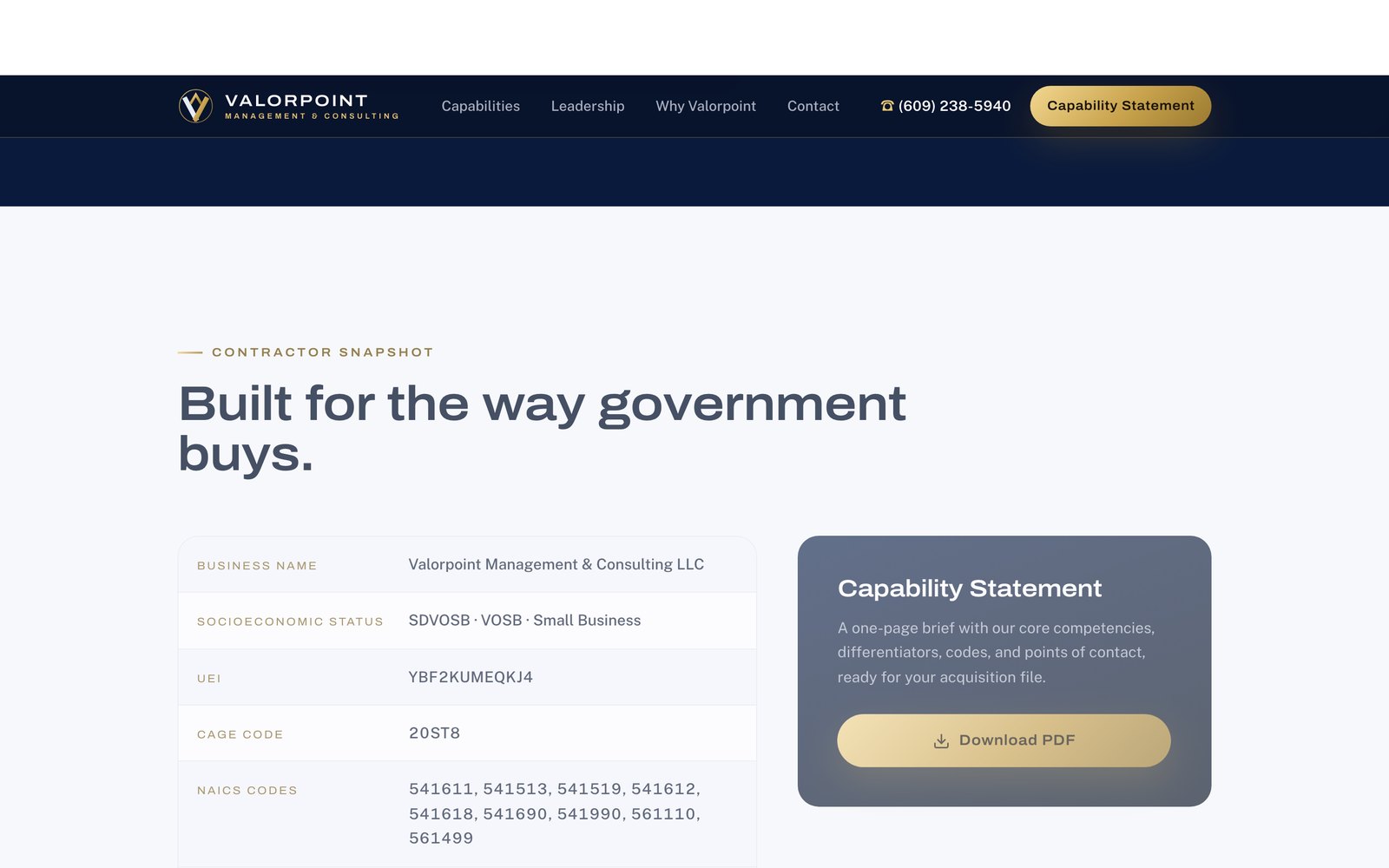
The contractor snapshot. Everything a buyer needs to qualify a vendor, on one screen, in the order they ask for it.
A site that only works on a fast, open connection is a site that fails the one visitor it was built for.
The Evaluation
Before launch, the site went through an adversarial pre-launch audit. Thirteen specialized reviews across six dimensions, with every finding re-verified against the source so only genuine issues were actioned.
6
Quality Dimensions
Accessibility, discoverability, accuracy, performance, robustness and security. Each reviewed on its own terms.
13
Specialized Reviews
Independent passes, each looking for a different class of failure, so no single reviewer’s blind spot becomes the site’s.
33
Items Verified
One critical, twelve high priority, twenty polish. Every critical and high-priority item resolved before launch.
Accessibility
Section 508 and WCAG 2.2 AA: keyboard navigation, screen-reader support, color contrast and document structure.
Search & structured data
Discoverability, social-share previews, sitemap and machine-readable business data.
Copy & accuracy
Every factual claim, certification and past-performance statement checked against source materials.
Performance & resilience
Load speed, asset weight, and the ability to render fully on a restricted network.
Cross-browser robustness
Consistent behavior across browsers and devices, with graceful fallbacks.
Credibility & security
Government-contracting presentation standards and web security best practice.
The Critical Finding
The audit found one launch-blocking item. The site loaded its motion libraries the way almost every site does, from a public content delivery network. On an open connection that is invisible and free. On a hardened federal network it is a blocked request, and the page arrives without the code that reveals its own content.
Every library was brought in-house and served from the site’s own origin, so there is no third-party runtime request left to block. A load watchdog was added underneath: if the motion runtime fails for any reason at all, the content reveals itself anyway rather than staying hidden behind an animation that never runs.
A visitor on a locked-down network now sees the same page as everyone else. That is the difference between a site that looks finished and a site that is.
Testing & Compliance
The live site was measured rather than admired. These are the checks that were actually run before it was handed over.
Keyboard navigation end to end, a focus-trapped mobile menu that is inert when closed, a main landmark and skip link, and color contrast brought to AA across the palette.
A full set of security headers confirmed present on the live response, with a content security policy and automatic redirect from insecure to secure connections.
Verified at 375, 414, 768 and 1440 pixels, covering phone, tablet and desktop, with zero technical errors recorded in the browser console on either.
Every certification, code and past-performance statement verified against the firm’s own documents. Nothing on the page overstates what it can evidence.
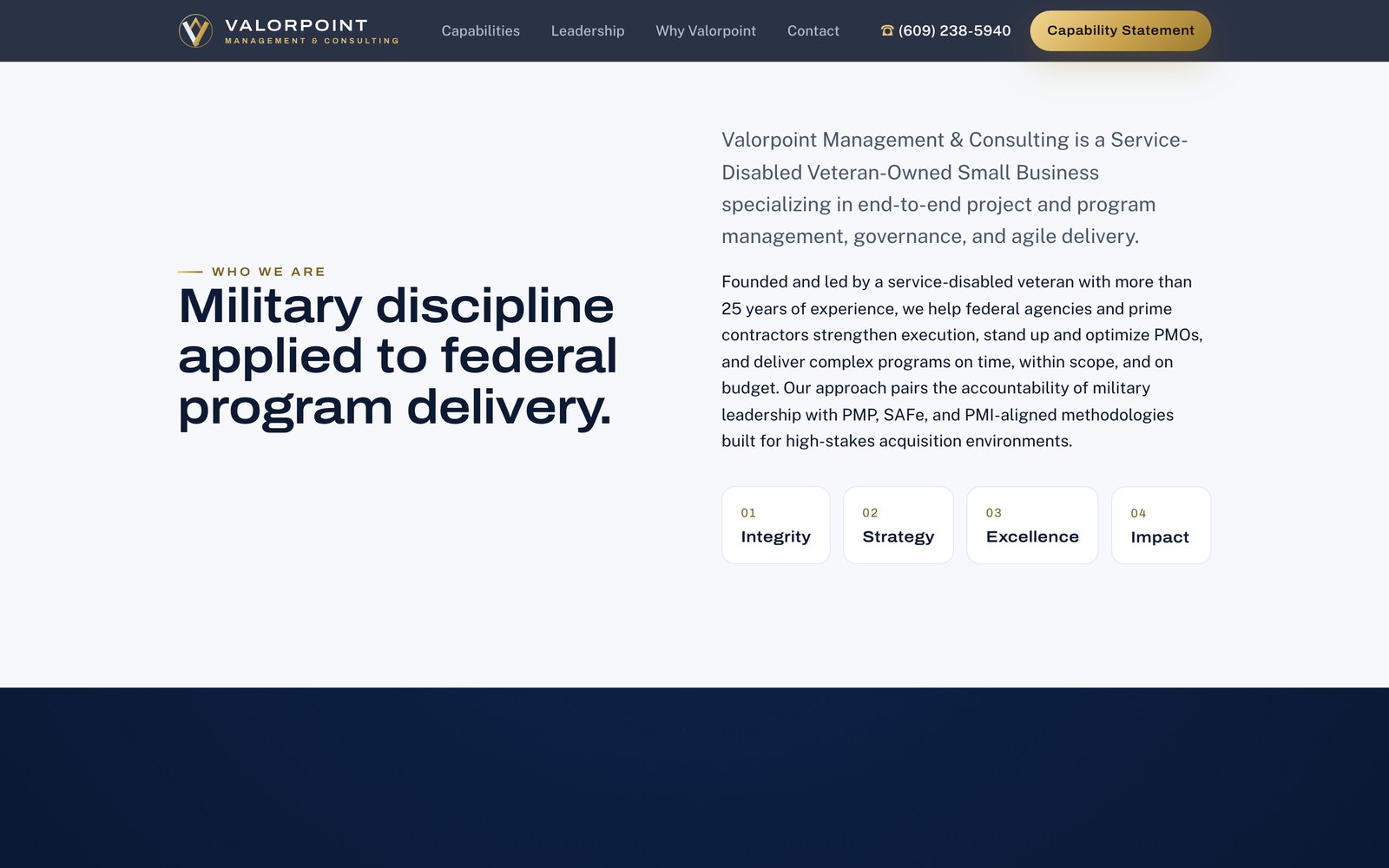
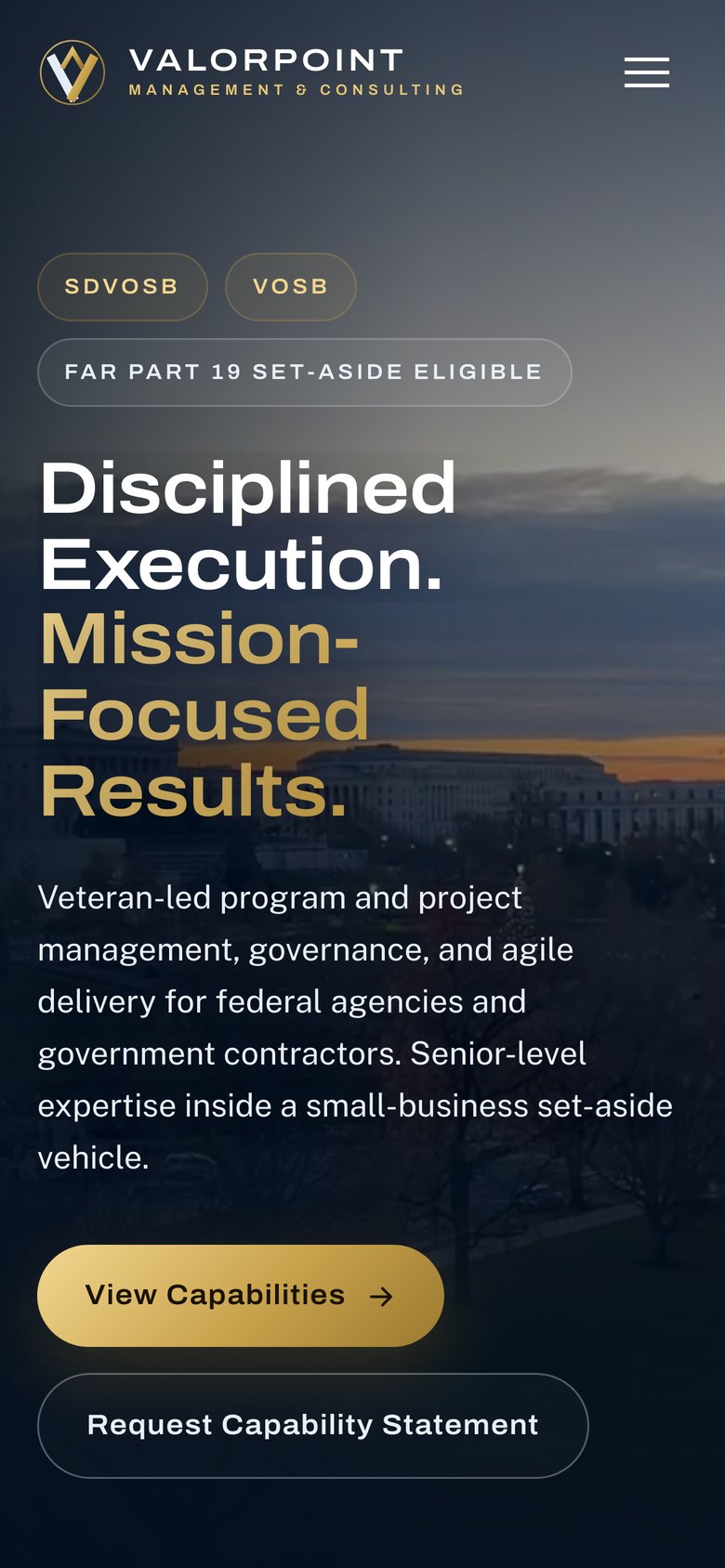
The same page, held to the same standard, on the desk and in the hand.
The Engine
A credible front door gets a firm considered. It does not tell them which of the thousands of federal notices posted each week are worth an afternoon. That is a different problem, and we built an engine for it.
The engine reads federal solicitations and scores each one against the firm’s actual position: the codes it holds, the set-asides it can claim, the size it can carry, and the past performance it can evidence. Six weighted factors, computed rather than guessed, with the reasoning shown and every claim tied back to a specific capability or contract on file.
The important design decision was to stop ranking by score and start answering a question the firm can act on.
A score of 35 reads as a rejection. But a notice can be technically perfect and still be un-primeable, because the set-aside belongs to a category the firm is not in. That is not a reason to walk away. It is the precise reason a prime in that category needs a veteran-owned partner on the bid. So every notice carries a path.
PRIME
Eligible, in domain, inside the size the firm can carry, and with evidence behind it.
SUB
The scope fits but priming it does not. Target the likely prime instead.
TEAM
A set-aside the firm cannot claim. That is the reason to be someone’s partner on it, not a reason to pass.
PASS
Outside the registered domain entirely.
It is built to be honest about the firm it serves. Commercial past performance is real evidence, and it is not federal past performance, so it is weighted below it and labeled as what it is. Being registered for a code is not the same as being able to evidence it: where there is no capability and no comparable contract behind a scope, the engine refuses to call it a prime opportunity and says why.
A capture tool that recommends pursuing everything is worse than no tool, because it adds confidence to the same unfiltered list. This one is designed to say no, and to explain the no.
The engine is built, gated behind a branded sign-in, and running against SAM.gov-shaped notice data. It is being prepared for deployment on the firm’s own domain and is not yet in production use.
The Outcomes
3
Days, Docs to Live Domain
Documents arrived on the 16th. The site was live on staging on the 17th and answering on the firm’s own domain on the 18th.
0
Third-Party Runtime Calls
Nothing the page needs is fetched from someone else’s server, so a locked-down network has nothing to block.
4
Verdicts Per Solicitation
Prime, sub, team or pass. The capture engine answers what to do about a notice, not just how well it scores.
A veteran-owned consultancy now has a front door that holds up to the standards its buyers are bound by. Designed, evaluated, tested and hardened.
Figures describe the delivery and the pre-launch audit. Past-performance values shown on this page are the firm’s own, verified against its source documents.
We will walk through the Valorpoint build live: the design, the six-dimension evaluation, and the testing that has to pass before anything goes to a buyer who is bound by standards.